Sunday, October 20, 2013

Courgettes Farcies (Seafood Stuffed Zucchinis)


Being up to my eyeballs in my dissertation continues to put my blogging mostly on hiatus (I'll be done in December!), but a woman's gotta eat, and if you gotta eat, you might as well cook, right? (And if your husband wants to try out his new camera lens, he might as well take food pics... It's a slippery slope.)

The French seem to love to stuff things, and I am learning to love it too. It's a nice way to compose a balanced dish, putting rich meats and sauces in with vegetables, keeping leaner meats from drying out, and stretching pricey ingredients with a bit of cheap starch and veggies. And, of course, it looks cool.

Zucchinis in France are more commonly stuffed with ground meat, rice and tomatoes, but Brittany is famous for its creamy seafood dishes, which I love and wanted to do homage to. The sweet mild zucchini complements the crab meat, and since zucchini comes in a variety of sizes, you can make one for every appetite, from toddler to full grown man.

 I made this starting from a risotto base, because I wanted leftover risotto for something else. But if you're time pressed, feel free to skip that step and just saute the onion, then toss it with any sort of cooked rice, even Uncle Ben's.

Courgettes Farcies
Servings: 3
Time: about 45 minutes
Planning Ahead: None, aside from shopping
The Funny Stuff: Crab meat and cooked shrimp, Boursin
Virtues: More vegetables, more better. Creamy, cheesy, gooey goodness.
Downsides: Labor intensive
Calories: ~475


Ingredients
Some zucchinis (I stuffed two big and one tiny, but you could do three medium zukes, or 5-6 tiny ones.)
2 Tbsp olive oil
1/2 cup white wine (optional)
1/2 c. dry rice (I used arborio, but you can use anything other than glutinous rice)
1/2 large onion, diced
1 can of crab meat
1 c. cooked shrimp
3 Tbsp. creme fraiche
3 Tbsp. Boursin cuisine (or Boursin spread mixed with extra creme fraiche)
1/2 cup Gruyere or Comté

Directions
Start by making risotto. Warm the olive oil over medium-low heat in a sauce pan, and then add the rice. Stir it until the grains start to turn a little translucent around the edges, then add the onion, and cook it until it's also transparent.


Dump in the white wine, and stir vigorously.


Once the white wine has been almost fully absorbed, add 1/2 cup water, and stir thoroughly. You'll continue to add water 1/2 cup at a time and stir, every time it starts running low on liquid, while you're working on the other steps.


Slice the zucchinis in half lengthwise...


Score the zucchinis deeply with a knife, making a rectangle all the way around the seed area.


Pop the seed area out with your fingers. If you're feeling thrifty, throw them in the freezer and save them for soup. (I'll give a foreigner's guide to French soup making in the next post.)


Once you've got the guts out of the zucchini, microwave them on high for about 6 minutes to start the cooking process along. While you're at it, start preheating your oven to "really quite warm" (which for me was 220 C., or about 425 F.)

If you've been adding water all along, your risotto should be looking something like this, with nice plump distinct grains that are soft to the tooth.  (If not, cook it a bit longer.)


Take the half-cooked zucchinis, and lay them in a baking dish or on a cookie sheet. Lay a few shrimp in the bottom of each one.


Put the risotto (or cooked rice and sauteed onion), the crab meat, the creme fraiche, and the Boursin all together in a big bowl.


Grate about 1/4 cup Gruyere or Comte over the top, and then mix everything together.


Spoon the stuffing into the hollow of the zucchini.


Lay the remaining shrimp on top, and sprinkle the other 1/4 cup of grated cheese over the top.


Stick them in the oven, and pull them back out again when they're golden brown on top (about 15-20 minutes).  If they're not as brown as you'd like at 20 minutes, give them a minute or two under a broiler.


Enjoy!

All photo credits to Aaron Wood

Thursday, August 8, 2013

Paris Dining: Au Fil des Saisons

I've been really bad about writing posts about Paris. I've been working hard on my dissertation, which takes up a lot of time and sucks my will to live, or at least to blog and take photos. I've been in a bit of a rut with home cooking (see also, dissertation), so I haven't had much to food blog, unless you want me to write about the wonders of Picard (It's a wonder, don't get me wrong.) I've had a bunch of really excellent meals here, from the plebeian (rocking good ham pizza!), to the sublime (Atelier de Joel Robuchon for my birthday! Oh la la!) However, most of the places I have eaten are all well documented restaurants, covered by many excellent food writers, with pictures (which I hate taking in restaurants), and I haven't really felt like I could add a lot to the conversation. Paris has got to be one of the most blogged cities ever, when it comes to food. However, I just had lunch at a little gem off the beaten path, and it was so awesome, I felt like I had to share, photos or no.

Within a stones throw of my work is Au Fil des Saisons (6 Rue des Fontaines du Temple 75003 Paris). It's down a tiny little street, and is about 15 feet wide, with a very understated sign. You could blink and miss it. However, should you happen to find it, walk inside, say bonjour, and ask for a table. The owner speaks excellent English (although please be a good traveler, and at least start with "bonjour"), and is friendly and warm.

As noted, I've been having a lot of really good food in Paris, and before that, in California. Au Fil des Saisons is not the best restaurant I've ever eaten at. (That honor falls to Manresa, in Los Gatos. Sorry, Monsieur Robuchon. And I'm still holding out for The French Laundry, which is on my bucket list. I hear the food there is pretty decent.) It's not even haut cuisine. However, I have never eaten in a restaurant with such painstaking attention to detail. There is nothing here that is not lovingly crafted or chosen to be excellent. There are no "throw-away" dishes. Everything has been refined, from the amuse bouche to the coffee.

When I sat down, a tiny basket of potato chips landed on my table, golden brown, and very thin. They were very lightly salted, and had that nuttiness that comes with just the right amount of caramelization. The owner came by with the menu (on a free standing chalkboard), offered to explain it to me in English, and then very sweetly explained his recommended dishes slowly and clearly in French when I told him I was working on my French.

I started with a cold cucumber soup (something I discovered in Paris, and love on hot summer days. Also very popular with my two year old, so if you're trying to get your kid to eat more veggies...) Like most I've had, this was cucumber, creme fraiche, and mint. Lots of grated cucumbers for texture, and a little tiny scoop of basil sorbet (very sweet and pungent) in the center of it. The basil really made it pop, and stand out from the "liquid tzatziki" soups that I've been getting. Very refreshing. I reached for the bread to sop up the last of my soup, and noted that it was excellent, even by Parisian standards, chewy with a good crisp crust, and very slightly hearty.

Next, I had the volaille farcie, chicken stuffed with ground mushrooms. I was expecting a very French bistro implementation of chicken, but what arrived had strong Asian overtones. It looked very much like Thai "angel wings", with a drizzle of shallot sauce, and came with a colorful side of stir-fried julienned veggies, and what appeared to be a puck of plain white rice. The chicken wings looked tasty, but I braced myself for disappointment with the sides.

The chicken wings were excellent, as expected, with a savory ground mushroom filling stuffed under the skin of the wing, and cooked to crispness, with little pops of salt sprinkled on at the very end (a technique which I love, and Manresa also does to perfection.) I moved on to the veggies. As I suspected, stir fried in soy sauce, but quite good, neither over nor underdone. Finally the rice, and a pleasant surprise. What looked like plain white rice had been cooked in olive oil, with a little bit of onion added, and some matching pops of salt. Very simple, but done perfectly, and absolutely delicious.

I decided to forgo dessert in the interests of my waistline (next time!) and went straight for the espresso. The espresso is brewed by the owner, and is strong, sweet, and mellow with a hint of molasses. (Definitely not Cafes Richard.) The sugar was plain white, rather than raw, but that let the molasses notes really shine.

All told, it set me back 30 euro or so. A little on the pricy side (sadly, I am unlikely to bring my coworkers on a weekly basis), but totally worth it as a splurge. Next time I'll get dessert. I'm sure it'll be fantastic.

Saturday, August 3, 2013

How Do You Say "Thing-Fetcher" in French?

My daughter has been complaining bitterly for a week or so, because the two little Duplo figurines that came with her blocks (who she carries everywhere, and has dubbed La Fille and Le Garçon) have gone missing. We looked all over the apartment to no avail, and the nanny worriedly confessed to having taken them to the park one day, but swore they'd come home at the end of the day. I sighed, and made a mental note to hit the toy store sometime in the next few days, and then thought no more of it until this morning.

This morning, I was looking for a different missing toy, when I happened to look behind the radiator in her room. There were La Fille and Le Garçon! Also two pieces of toy fruit, one Duplo block, the digital thermometer (when did she get her hands on that?), and a small toy egg. Oh, and a pile of old, dusty crumbled paint coating everything. All of it about 18 inches down a tiny little crack too small for my arm, or even hers.

Were we in the US with all of our stuff, I'd head for the garage like the clever tool-using mammal I am, and go grab the tool that I, and everyone I know, calls a "thing-fetcher". It's that handy little deelybobber with the button on one end and claws on the other, sold at finer Home Depots and automotive stores everywhere. However, I had a feeling that if I marched into Leroy Merlin and asked for a "récupérateur des choses", I wasn't going to get very far. Further, as it turns out, even in English, it's not sold as a "thing-fetcher". It is a "pickup tool", which sounds ever so much more refined. A bit of Google Translate later, with a cross-check against some Google shopping results, and I managed to uncover that the tool I want is an "outil de ramassage". And that it is only sold in automotive stores. Which they don't have in Paris. Because everyone takes the metro. Damn and blast.

So in the end, there I was like every primate for the last millennia, fishing out her toys one by one with some sort of stick. (In my case, a plastic coat hanger, but a tree branch would have been just as effective. Maybe more so.) I damp-wiped the toys with a paper towel, and then washed them thoroughly, just in case that was lead paint, and then we vacuumed up the paint chips with a HEPA filter vacuum, and ran the HEPA air purifier in her room for an hour to catch any stray particles. We'll check with the owner about the age of the paint, but it's probably fairly modern.

In the mean time, the little duplo family is reunited, the thermometer is back in the bathroom on a high shelf, and now I just need to figure out how to get twenty-eight cents euro out of the 350 year old mortise and tenon joint on the stairs, where she carefully dropped them one by one...

Wednesday, June 26, 2013

The Idiot's Guide to Finding a Good Publication Venue (mostly in Computer Science)

So, here you are. You've gotten into grad school. You have had your first big idea, or maybe your second or third. You've done a bit of research, confirmed that it's viable, and now you want to find a conference or journal to submit to. But which one?

Alternatively, you are looking at papers from a field that you're not very familiar with. You've found a paper you think is interesting, but you're not sure if it's a good paper from a reputable publication venue, or junk science from The International Journal of Crackpot-O-Rama. How do you find out? (Hint: citation count is not the whole story.)

Here, then, is a brief guide to figuring out out whether a conference or journal is a good venue, and you should send papers to it, or trust papers from it. This guide is mostly drawn from computer science, since it's the area I know best, but I think most of the principles generalize to other scientific disciplines. The humanities are entirely different, so someone else will need to help you out there.
  1. How broad is the charter of the venue? Do they cover everything from AI to Z-order curves?
    Venues with a very broad purview are often paper mills. The canonical example of this is, of course, The World Multiconference on Systemics, Cybernetics and Informatics, but there are many others in that vein. A good venue has a clearly defined scope, usually on a single area of specialization or special interest topic. (For instance, SuperComputing takes papers on systems, programming languages, computer engineering, and visualization, but it's all very clearly focused on "problems people with supercomputers have".)
  2. How diverse is the program committee? Is their nationality all the same, are they all from the same few universities, or does the nationality of the members closely match the country where the conference is held?
    There are a lot of smaller regional conferences in a topic area which are held in a specific country, and draw their entire PC from there (China and India have a number of these, and since they're large countries with lots of universities, some of them are pretty good, but you should still examine them closely. The US does not get a pass on this, either.) This isn't a terrible thing, and sometimes good papers wind up in regional conferences, but it suggests that these are smaller fry, not the top tier venues in a field. A really good venue is prestigious to serve on, as well as to publish in, and it can usually attract PC members from all over the world.
  3. What is their acceptance rate? (Do they publish their acceptance rate?)
    A good venue will probably get more papers than they can publish. Some good venues are extremely exclusive. Others try to be able to accept more good papers, so they have more tracks, special issues, short papers, etc., but they're still going to wind up rejecting a lot. Somewhere in the 10%-20% range is good, 30% is OK (The World Multiconference not withstanding), more than that is a little suspicious. Less than 10% probably means that the papers they accept are really good, but they're probably not a great submission venue, unless you have something truly earth-shattering, AND you write like a god. If they don't publish it at all, be very wary.
  4. Pick a steering committee member, or a couple, and go look at them on Google Scholar. What's their H-index like? Are they well cited? (How does their H-index stack up to your advisor's?)
    While PC members are sometimes recent PhDs who have shown show promise in their field, the steering committee should be well established, and have done a lot of high-quality research in the venue's area.


    If a venue hits all four of these points, it's probably a good venue where you can submit your work without besmirching your good name forever. However!

  5. Not all papers in good venues are fantastic papers. If you're looking at a paper from a good venue, it's been through a round of peer review, so the blatantly awful has probably been thrown out. But that doesn't mean that it's a stellar paper. A bunch of things can collude to let a less than good paper slip in.
    1. They didn't get a lot of good papers.
      Sometimes the pickings are slim, and venues aren't going to cut back a whole day, or skip an entire issue, just because they didn't get great papers. So less good papers will, grudgingly, get accepted. (Although they'll often also step up the invited talks and highlight papers, which is another indicator you can look for that a given year was not as good as usual.)
    2. The reviewers were really swamped, and not as on the ball as they should have been, or weren't as expert in that sub-area as they needed to be.
      Sadly, this happens too. Reviews are run entirely on volunteer effort, and that means sometimes there just aren't enough expert reviewers to go around. A paper which looks superficially good may have deep flaws that someone in a rush, or not deeply read in a sub-area, might miss. Maybe the idea was sound, but their evaluation methodology was flawed, or vice versa. Maybe it's a great idea, but someone invented it 20 years ago in a different discipline. Always, always, do your own leg work, especially when it comes to related work and experimental methodology. Never assume that just because someone said it in a conference last year that it's right, or appropriate for your problem.
    This is where things like citation count start to come in. Now that you've determined that the venue itself is good, now you can start asking questions like "How many people have cited this paper?" and "How many people cite papers by people who cite this paper?" (In other words, doing the whole PageRank thing.) But there are a lot of reasons not to trust raw citation counts, especially in contentious areas. People may cite the paper just so they can debunk it. Bad scientists may cite the paper because it agrees with what they believe, even if it's not actually that great of a paper. The best papers will have lots of citations, from good researchers, who say positive things about it in their papers. If it's a really recent paper, then you're going to have to go off the person's previous publication track record, or their advisor's, if they're really new. (On the other hand, it's rare for someone's first or second paper to be really good solid work.)
As always, however, your best guide to publication venues is going to be people who know that area. If it's your area, and you're new to it, ask your advisor or senior lab mates to tell you what's good. If you're looking outside of your area, see if you can find a research buddy in that discipline. Good luck, happy reading, and happy publishing!

Thursday, June 20, 2013

Coriander versus cilantro: the confusion continues.

Things I learn... I thought I knew that coriander (the dried herb) and cilantro (the fresh leaf), both came from the same plant, but that Europe doesn't distinguish between the two, calling them both coriander. However, I was flipping through On Food and Cooking just now, and discovered that the reason why Americans call fresh coriander cilantro is because there's a Central and South American herb called culantro (Eryngium foetidum), which tastes much like the Middle Eastern herb, coriander (Coriandrum sativum), and has mostly been displaced by it throughout Latin America. So odds are good that your guacamole was made with coriander. But to add another twist to the story, culantro lives on. It's still sometimes used in Latin America, but it has been enthusiastically adopted by Asia, especially the Vietnamese, who use the leaves as a substitute for Vietnamese coriander, Persicaria odorata (which is neither a coriander nor a culantro). So your cilantro is probably coriander, unless you're eating Vietnamese, in which case it might be culantro, or something else entirely. As a side note, the unpleasant "soapy" flavor that some people are sensitive to is the result of a fatty aldehyde, decenal, also present in citrus peels. So if you don't like cilantro, you probably won't like citrus zest, or citron, the much-maligned fruitcake ingredient. (Then again, why are you eating fruitcake, when you could be eating this?) It's not present in the seeds, however, so most people who hate the taste have no problem eating coriander heavy cuisines such as Indian. It's also heat sensitive, so it's possible that lightly cooking the cilantro would drive off the offending soapy component. However, most of the other flavor compounds in cilantro are even more volatile, so it'll probably just taste grassy. Try it at your own risk.

Wednesday, April 24, 2013

Adventures in Paris, Part 1 of many: In which I completely fail to buy an onion.

As may have already become clear in previous posts, I don't have the best luck when it comes to onions. I tend to run out at inconvenient times, or forget to buy them, or find that the ones I have are rotted just when I'm getting ready to cook. However, I've never actually failed at purchasing one before.

Aaron ran out to grab a few things for dinner and breakfast the first day we arrived, but today has been the first day I've felt up to navigating a French supermarché, and we needed groceries badly. So I gathered my bags, put together a bilingual shopping list, and went merrily off to to the Carrefour. Unlike the small shops, which are very helpful, the supermarket experience in France is generally not so different from the US (which is to say, apathetic), and one can wander up and down the aisles in peace, quietly gawking at the yogurt (100+ kinds!), the ethnic food aisle (fresh ramen noodles! Tortilla chips! nuoç mam!), and the meat case (smoked duck breast! Whole rabbit!)

I managed to find everything on my list, and went off to the cash register, feeling very proud of myself. Remembered to say bonjour, and was happily bagging my groceries, when the cashier started brandishing the single onion I bought for tonight's dinner, and asking me a question. The first time around, I missed it entirely, catching only the oignon at the end. I apologized and asked her to repeat herself, but didn't get much further, aside from balance. I looked around in vain for a cashier's scale, and then realized there didn't seem to be one.

We tried to bridge the linguistic barrier, but to no great success. I still have no idea what I was supposed to do with the onion. All I can guess is that I was supposed to weigh it myself. At the checkout somewhere? In the produce section? (Perhaps there's a way to label the bag I missed?) After several rounds of apologies between the cashier and I, it was decided that it would be better for everyone if I did not, in fact, buy the onion. I left with two full bags of groceries, and no onion. After getting home and thoroughly laughing at my predicament with Aaron, I hopped downstairs to the tiny family grocery right under our flat, where they smiled at my terrible French, and helpfully typed out my total so I knew how much to pay them for my two small onions. Getting over the constant interaction and the language barrier is a little intimidating, but there's a lot to be said for genuinely friendly customer service.

Tuesday, May 15, 2012

Matters of more substance...

I was having a discussion today with the inimitable Mr. Teacup over on Twitter. I decided to summarize my thoughts in a less compact form, thus also giving him room to respond in more than 140 characters, and perhaps we can have a pleasant discussion. Or a well-reasoned unpleasant discussion, or who knows what, but at least we'll have room for it.

I don't know much of Mr. J.W.R. Teacup, Esq., but he has generally proven to be a well read and thoughtful dude, albeit perhaps further steeped in Marxist theory than I normally go for. (I'm more for pu-erh, or a nice chamomile. Marxists are often terribly bitter when oversteeped, although they add a pleasant flavor when part of a blend of other thinkers.) He is not, to the best of my knowledge, an engineer of any flavor, although it's quite possible. Which brings us to the current topic of discussion.

We were both holding forth on a subject somewhat near and dear to my heart, the question of whether everyone in the world should learn to code. He initially pointed out the post by Jeff Atwood titled "Please Don't Learn to Code" in which Jeff, a programmer himself, rightly points out that most people will never need to code, will be terribly bad at coding, and probably ought to focus on other things in life. All of which I hold to be true. However, I still believe everyone in the world should learn to code.

Actually no. I don't believe that. Here's what I do believe. Everyone in the world should be exposed to the practice of logic, of critical thinking, of problem decomposition, of forming hypotheses and testing them by painstakingly changing one variable at a time. The reason why I advocate for programming over any other science or engineering discipline is as follows. Computers are ubiquitous. Computers, at least these days, are pretty much unbreakable to a novice (ah, those halcyon days of setting IRQs by hand!) You can make a mess of things in your little sandbox, but a reboot will fix almost anything you may have done short of deleting your hard drive. Code is highly repeatable, unlike frogs. Type the same line of code 10 times, and it will do the same thing. And the behavior of your code is not already known, unlike the laws of physics, so you can't cheat by looking it up on the internet or in the back of the book. And you don't even need to know algebra!

This makes programming a superb microcosm for teaching and demonstrating the principles of certain types of well structured thought at a fairly early age. I will cheerfully agree that most people will suck at writing code. However, I believe that the process of learning how to write code will make them better people in a fundamental way, similiarly to the way that learning to critically read Stendhal will make them better people, despite knowledge of Stendhal being one of the most useless things known to man. The act of critical thought in and of itself, the ability to analyze, dissect, and be aware of one's own assumptions is a key part of an education, and one that I think is sadly lacking from both engineering and the liberal arts. Engineers avoid literary theory, claiming it's full of unwashed anarcho-Marxist hippies, literary theorists decry engineering as an oppressive tool of patriarchy and false consciousness, and both sides lose out on key intellectual tools.

Wednesday, March 14, 2012

A Month of Food Blogging (15 of 28) : Salisbury steak


Salisbury steak always makes me think of TV dinners, greasy, gristly meat, gravy loaded with MSG... I'd better stop, I'm grossing myself out. It's actually a really tasty dish, when made from scratch. It won't win any elegance awards, but it's hearty and savory with a nice beefy, meaty tone to it, and it's quick to make and inexpensive.

Until I started doing research for this post, I didn't know where the name came from. I had always assumed it hailed from Salisbury, England. Somehow in my head, adding bread crumbs to meat to stretch it seems like a very British thing to do. (I think it's the bangers.) But, thanks to the wonders of Wikipedia, I am now informed that it takes its name from Dr. James Salisbury, an early proponent of low-carb dieting. I'm not entirely certain why he favored chopped beef, versus a perfectly good steak, like most carnivores. However, the original Salisbury steak contained no bread crumbs. Internet rumor has it that it was a modification by thrifty WWII housewives, to stretch precious beef supplies a little further.

Salisbury Steak


Servings: 2
Time: about 30 minutes
Planning Ahead: None
The Funny Stuff: No funny stuff
Virtues: Easy, fast
Downsides: None, really. A bit on the high fat side.
Calories: 423

Ingredients
1/2 lb ground beef
1 tsp salt
1 tsp worcestershire sauce
1 egg
6 saltines
1/2 an onion, minced
1 sprig of fresh thyme, or 1/2 tsp dried thyme
pepper to taste
2 cups sliced mushrooms
The other 1/2 an onion, sliced
2 Tbsp flour
1/2 cup red wine
1 Tbsp beef soup base
1/2 cup water


Directions
Combine the beef, salt, and worcestershire sauce, and let sit for 10 minutes. While it's sitting, prep all of the veggies, and preheat your skillet to medium, and your oven to 350.

Add the thyme, cracker crumbs, egg, and onion.


Goosh everything together. (I'm pretty sure gooshing is the technical term for this operation.)


Form into hamburger style patties, and drop into the pan.


Cook 3-5 minutes, until brown on the first side, and flip.


Once they're brown on both sides, pop them in the oven on an oven-safe dish, and add the onions to the pan, stirring occasionally.


Once the onions are softened and starting to brown a bit, add the mushrooms, and toss them until lightly cooked.


Sprinkle the vegetables with two tablespoons of flour, and toss to coat.


Deglaze the pan with the red wine, stirring quickly to prevent the flour from making lumps.


Let that reduce a bit, and then add the beef base and water.


Stir everything together, scraping the pan to get the reduced wine up, and voila, you have a lovely brown gravy.


Pour the gravy over the meat, and serve.


Photo credits to Aaron Wood and Aleatha Parker-Wood.

Wednesday, March 7, 2012

A Month of Food Blogging (14 of 28) : Cassoulet, deconstructed.


Every culture has a dish which seems to translate to "we threw some leftovers together." In the US, it's often chili (or the dreaded "casserole"). In Italy, it's panzanella. In France, it's the dish known as cassoulet. Cassoulet is composed of beans and a menagerie of meat, slowly simmered in water and fat until the beans are tender and infused with meat flavor. Escoffier calls for pork rind, pork belly, and garlic sausage. The full Toulouse treatment calls for garlic pork sausage, pork rind, duck confit, mutton, and/or partridge. Oh, and it's got breadcrumbs on top. You get the idea. Leftovers. However, at its essence, it's a story about beans, slow cooked in broth and fat, with a bunch of thyme and some meat. The kind of dish you want to come home to on a cold winter's night. This is a heavily stripped down version of the real deal (which I also love), but this one takes about 5 minutes in the morning, and is amazing when you get home. The kombu is there to add an extra kick of glutamates, and the baking soda makes the skin of the beans more permeable, so they get more tender and soak up more flavor, without disintegrating.


Cassoulet


Servings: 4
Time: 5 minutes of prep, 8 hours cook time, 5-10 minutes of finishing touches.
Planning Ahead: Start it in the morning
The Funny Stuff: Flageolet beans, kombu, duck fat (optional), chicken confit (optional, but highly recommended)
Virtues: Easy, high in fiber
Downsides: High fat
Calories: 324 (not counting the confit)

Ingredients
1 cup flageolet beans (or large white beans)
1 1/2 Tbsp chicken soup base
About 5-10 sprigs of thyme
2 chunks of kombu, about 2"x4" each
a pinch of baking soda
1/4 cup duck fat or olive oil
6 cups water
1 smoked brat, or other neutral flavorful sausage (garlic is traditional, Polish is pretty good, andouille is a bad idea. I checked.)
2 chunks of chicken or duck confit


Directions
Put the beans, soup base, thyme, kombu, and baking soda in a crockpot.


I do literally mean a pinch of baking soda.


Add the duck fat and water. You can either add the sausage now, or at the end. If you add it now, it will permeate the beans, but the sausage itself will be bland at the end.


Set the crockpot for low, and let it cook for 8 hours.

If the beans are still a bit soupy, reduce some of the cooking liquid, by transferring it to a pot and boiling it on the stove for a few minutes. If you didn't add the sausage at the beginning, heat it up (30 seconds in the microwave will do) and chop it in. If you're having it with confit, heat that up as well, and place it on top. We had this with baguette and green salad, and the baby got minced sausage and beans and a vegetable.


Photo credits to Aaron Wood and Aleatha Parker-Wood.

Tuesday, March 6, 2012

A Month of Food Blogging (13 of 28) : Crockpot confit


Confit is a word that conjures visions of French bistros, long conversations over wine, espresso at 9 PM. It's not a ticket to Paris, but it's at least a nice reminder. As with most French cooking, it takes a long time to make, but most of that time is spent waiting around, working your way through the collected works of Molière and sipping wine.

As I mentioned in my last post, the magic of confit lies in the salt and the low temperature cooking. A long salting process breaks down the muscle and pulls the water out of the cells, making it very tender. Then the low temperature allows the meat to cook without causing the muscles to tighten and dry, and the oil drives out any remaining water.

Originally, confit was a way to soften and preserve the very tough legs of ducks. Once the meat was confited, it was left to cool in the duck fat. Between the salt and the fat, it could be kept in a cool dry place for months, making it a good way to put meat by for the winter. (Assuming, of course, that you didn't develop botulism in the anaerobic conditions under the fat, as occasionally happened.) These days, we have refrigeration, but it's still a great way to make meltingly tender meat. Here I've used chicken thighs rather than the more traditional duck, and it's still delicious. You can also swap out the duck fat for olive oil or other fats, if you just cannot get your hands on duck fat. If you do get duck fat, it can be reused several times, until it gets too salty, at which point, I recommend using it for potatoes Sarladaise.

Once you have made confit, it's very versatile. You can serve it atop cassoulet, as I'll do in my next post. You can shred the meat and use it to make a very fancy macaroni and cheese, a la Calafia Cafe, or put it in ravioli. You can certainly just re-heat it and eat it straight. It also freezes really well, again, because there's very little water in it.


Crockpot confit


Servings: 2
Time: 10 minutes of prep, 1-2 days salting time, 8 hours cook time.
Planning Ahead: Must be salted at least 8 hours in advance and then cooked for 4-8 hours.
The Funny Stuff: Duck fat.
Virtues: Very little effort
Downsides: Lots of fat
Calories: Depends on how much fat the meat soaks up. (I have no idea.) Minimum 150 calories, max, 200?

Ingredients
2 chicken thighs or duck legs
2-4 cups duck fat, enough to cover your chicken in the crockpot (can be strained and reused)
2 tsp kosher salt
1 sprig fresh thyme
2 cloves garlic


Directions
Set the chicken thighs in a bowl, or baking dish. Sprinkle both sides of the chicken thighs with salt, trying to cover them as evenly as possible.


Crush the garlic, and sprinkle it and the thyme over the chicken. Cover the dish, and set it in the fridge for at least 8 hours, and up to 48.


The next morning (assuming you are aiming for dinner), take the chicken out. There should be little to no salt left on the surface. Some people brush off the thyme and garlic at this point, because it makes the oil messy, but I like the flavor it adds to the oil. Pop it in the crockpot. Take your duck fat, and warm it up a bit, so that you can pour it, or at least spread it.
Pour it over the top of the chicken, set your crockpot to low, and walk away.


Come back 6-8 hours later. Voilà. You have confit.


Here it is over some cassoulet. (Sneak preview of the next post!)

Photo credits to Aleatha Parker-Wood.

Thursday, February 23, 2012

A Month of Food Blogging (12 of 28) : Love like salt (or, chemistry in action)

Well, that was exciting. In the last month, my laptop started overheating due to a bum fan, my grandfather passed away, I passed my qualifying exams (I am a doctoral candidate!), my daughter started teething, and in general, the universe threw me a series of curve balls. But the laptop is fixed, the exams are passed, the daughter is well stocked with cold teething rings, and I'm ready to get back to this project. I'm clearly no longer aiming to do 28 posts by Feb 28th (that would require a time machine), but we'll still aim for 28. (29, really, as I plan to do a retrospective on lessons learned at the end.)

Today, I'd like to branch out a bit from recipes, and talk a bit about sodium. And time. And the beautiful things that sodium can do for you.


Sodium gets a bad rap for a variety of reasons. It's often used in lieu of other, more flavorful, ingredients, in order to make cheap things tasty (both as salt, and in conjunction with glutamates, as MSG). It has a reputation for causing high blood pressure and heart disease. (An undeserved one, by the way. Check out the Cochrane Report on salt and hypertension for the current state of medical science. In summary, it does have minor effects on blood pressure, but only on the order of a point. And a reduced sodium diet can lead to increases in cholesterol and triglyceride levels, which are rather more strongly correlated with heart disease than blood pressure.) However, it can still have bad effects on the kidneys in large amounts. Given all that, a lot of people over-react, and try to avoid salt entirely.

I don't advocate going off and eating salt by the tablespoon, and most pre-prepared foods have far more salt than they need. However, when you're scratch cooking, a little salt at the right time can do wonders for your cooking.
  • Salt is tasty
  • Salt is a natural preservative
  • Salt is a meat and vegetable tenderizer
  • Salt softens beans and helps them cook faster
  • Salt makes bread dough more elastic
  • Salt makes eggs more tender

Let's wander down the garden path of chemistry for a bit, and talk about why some of these things are all true. Salt is composed of sodium and chlorine, in an ionic bond. However, like some couples we all know, all it takes is a little liquid, and the bond becomes very weak, breaking the salt into a sodium and a chlorine ion (charged particle). Now, sodium and chlorine are both notoriously promiscuous and will cheerfully glom on to anything that will have them. (I'm going to run this metaphor for all it's worth!) When you put salt in bread, the sodium will happily hook up with the gluten, and cross link it, so that many long chains of gluten are stuck together in a matrix (kind of like a snarl in hair). This strengthens your bread dough, and lets it rise to fluffier heights. (Ever notice how Italian bread is usually flatter and denser than a French baguette? That's at least in part due to the low salt content of traditional Italian breads.) When you add salt to eggs, it also sticks to the proteins, but egg proteins don't link to each other as well when there's a sodium in the way (unlike gluten), so they can't form a tight mesh to get all stiff. Thus, adding salt creates very tender eggs. (And is why you never salt a meringue, because it won't set properly.)

When you add salt to vegetables, a slightly different set of things happens. Vegetables have a bunch of water. but it's normally all locked up in the cells. The salt sets up what's known as osmosis, and begins to suck water through the cell membranes. In the case of veggies, it means that they start to soften, as the water is pulled out, without having to rupture the cell walls and make the vegetable mushy (as boiling does.) This is part of why pickles have the texture they do, as the salt softens the pickled vegetable while still preserving a bit of texture and crunch.

In the case of meat, something even more magical happens. If you salt meat and let it sit for just a few minutes, or cook it right away, the salt will pull all the water out of the meat, just like it did the veggies. This is terrible. The muscle fibers get very dense, the meat gets very dry and chewy, and it's impossible to brown the meat, because it's leaking water. This is why you don't salt meat during cooking if you're using a fast cooking method, like searing. However, if you let the salt sit for a while, the meat begins to draw the water (and salt) back in. According to the eminent Harold McGee, this is due to reverse osmosis, but I've never been able to figure out where the pressure for RO would come from. It matters not. What matters is that if you salt your meat early (like 6 hours early), you will have incredibly tender, juicy meat, because the salt begins to break down the muscle fibers, while holding the water in, and the salt will permeate all of the meat, instead of sitting on the surface. This is the secret to dishes like confit (which I will talk about in my next post.) A long salting process allows the meat to become very tender, and then it's followed by a low and slow cooking process in oil, so the oil can displace all the remaining water without toughening the meat again.

There's many more applications for sodium (I haven't even gotten to beans, and why a little salt and a pinch of baking soda is the best way to cook beans), but this post is running a bit long, and it's late, so I think I'll save it for another day.

Sunday, February 12, 2012

A Month of Food Blogging (11 of 28) : In which your author attempts Kadu with meat sauce and only sort of succeeds.


I had some bad family news earlier in the day, and Husband had been working over the weekend (and was unavailable for photography duties), so I was a little off my game. I considered simply not writing this one up, but thought the process of recovering this meal from disaster might be educational, or at least entertaining.

Kadu (technically Kadu Qima, since I am making it with meat sauce) is a traditional Afghan dish, made with pumpkin. However, Afghani pumpkins are apparently much more flavorful than American pumpkins, so it's common to see people make it with the more meaty butternut squash. It's essentially roasted squash with a bolognese over the top, finished off with a dollop of yogurt-mint sauce. I often make a cheater version of this, starting with canned spaghetti sauce, which is also quite delicious. However, I decided to get all fancy, and do a proper kadu, starting from this recipe and this recipe. Getting fancy may have been my first mistake. Read on.

Butternut kadu


Servings: 2
Time: 23 minutes
Planning Ahead: None
The Funny Stuff: Garam masala, ginger, other exotic spices
Virtues: Fast, high in vitamin A, low fat, reasonable sodium content.
Downsides: None. It's awesome.
Calories: 395

Ingredients
1 small butternut squash
1/2 lb ground beef or lamb
1/2 tsp salt
1 onion. If you, um, had an onion. Crap.
2 cloves garlic, crushed
2 cubes prechopped ginger, or 1/4 inch of fresh ginger
1/4 tsp cloves
2 tsp coriander
1/2 tsp turmeric
a couple whole cardamom, or 1 tsp ground cardamom
1 tsp garam masala
1 14 oz can diced tomatoes
6 oz plain yogurt (preferably low fat Greek)
1 tsp dried mint
1 clove garlic
1/2 tsp salt


Directions
Set out your ingredients. Realize you have forgotten to buy onions for the third time this week, even though you JUST went to the grocery store to buy yogurt for this recipe. Swear like a sailor, causing both your infant daughter and husband to look at you with deep concern.


Shrug your shoulders, aiming for Gallic insouciance. Chop your squash into rounds. Pop it into a microwave safe dish and microwave it for 8 minutes. Preheat the oven to 350 degrees.


While the squash is microwaving, start your ground beef browning in a skillet with 1/2 tsp salt sprinkled over. When the squash is done in the microwave, put it on a cookie sheet, and pop it in the oven with a 15 minute timer.


If there were an onion, you would now add it, chopped, and brown it with the meat. But there is no onion. Hunt around your cupboards in case there is an onion that has materialized, in amongst the teething biscuits and cheerios. In desperation, fish out some green onions from the fridge. Chop them finely. Add those, along with some spices, the 2 garlic cloves, the ginger, and the canned tomatoes.


Stir that all together. Decide that the green onion just isn't going to cut it. Add a metric boatload of onion powder. (Which is slightly smaller than an imperial boatload, as determined at the Treaty of Calais in 1889, after the British navy forcibly proved that their ships were, in fact, larger than the French ships, and demanded that the French not call them "boats" any more. (OK, I may have made that last bit up)). Stir everything together, and let it simmer.


While it is simmering, add the garlic, mint, and 1/2 tsp salt to the yogurt. Stir it all together and let it sit so the flavors can meld.


Taste your pretty, pretty sauce.


Discover that it is tragically bland. Swear some more, but softly, and in a foreign language this time, so as not to teach the baby bad words. Add more of everything. (Bringing us up to the totals described in the recipe.)


Simmer some more, and discover that it is now delicious. When the squash is done baking, pop it onto a plate, cover it with meat sauce, and a dollop of yogurt.


Sit down to eat your tasty meal, only 23 minutes and 5 swear words later. Baby had some of everything, and loved it.

Photo credits to Aleatha Parker-Wood.

Saturday, February 11, 2012

A Month of Food Blogging (10 of 28) : Seafood Carbonara


This recipe is very rich, but it's fast and delicious. We usually eat it with a hefty green salad. You can also eliminate the bacon all together (it's only about 40 calories per serving, but perhaps you're watching your saturated fat, or keeping kosher), and substitute olive oil for the bacon fat. If there's no bacon, I like to add some smoked salmon or trout to bring the smoky flavor back in.

Seafood carbonara


Servings: 2
Time: 15 minutes to thaw seafood, 15 minutes to cook
Planning Ahead: None, unless you want to thaw the seafood in advance.
The Funny Stuff: Block parmesan (or good quality pregrated parmesan)
Virtues: Fast, high in omega-3s
Downsides: Lots of fat from cheese and eggs, high cholesterol from the shrimp, lots of carbs.
Calories: 446

Ingredients
4 oz angel hair pasta, dry
2 oz parmesan
2 eggs
1 Tbsp parsley, chopped (optional)
1 slice bacon
4 large scallops
4 large shrimp
3 cloves garlic

reserved pasta water


Directions
If the shrimp and scallops are frozen, then thaw the shrimp and scallops in a ziploc in warm water. While the seafood is thawing, bring 4 cups water to a boil.

While the water is heating, shred the parmesan in the food processor. Crack the eggs over the shredded cheese, add the parmesan, and stir everything thoroughly.


When the water comes to a boil, add the pasta. Set a pasta timer for 12 minutes. Brown bacon over medium heat.


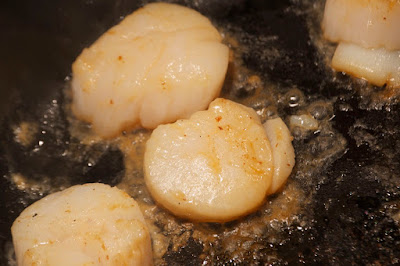
When the bacon is browned, remove it from the skillet, and add the seafood to the bacon fat, turning it every few minutes.


When the scallops are starting to crack, and are no longer translucent, the seafood is done.


Crush the garlic in with the seafood, and stir. Reduce the heat to medium low.


The pasta should be done at this point. Drain the pasta, reserving about a half cup of pasta liquid. Toss the pasta in the skillet with the seafood. Crumble the bacon over the top, and toss the noodles to coat them in the bacon fat and seafood juices.


Turn off the heat, and immediately, while the pan is still hot, add the egg and cheese mixture on top of the pasta. It needs to be hot enough to cook the egg and cheese, but not so hot that the egg cooks before it coats the pasta. Stir thoroughly.


Once the egg is incorporated, turn the heat on low again. Add the reserved pasta water (which should still be hot) a tablespoon at a time, stirring, until the pasta sauce reaches a creamy consistency.


I like mine moderately creamy, so I added about a quarter cup, but it's entirely a matter of taste.


Enjoy!


Photo credits to Aaron Wood and Aleatha Parker-Wood.